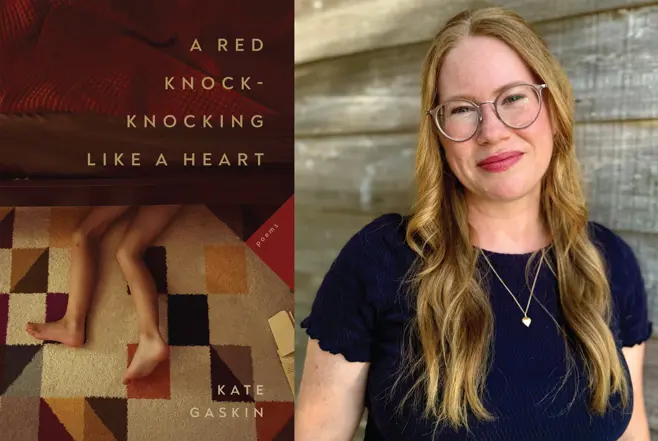
Just when I thought I was ready to move away from the phrase “beautifully heartbreaking,” I held in my hand Kate Gaskin’s book of poems with its feathered edges (because I carried it everywhere) and thought, beautiful and heartbreaking. The beauty in Gaskin’s second collection of poetry, A Red Knock-Knocking like a Heart, is everywhere—its lyrical language, its meditations on nature, its unabashed honesty. They are in the quiet and joyful moments, and sometimes the beauty unfolds in tender and surprising ways. Precisely when Gaskin draws you into this remarkable world of wonder is also when you come face to face with unfathomable loss, the isolation that lingers, and the startling possibilities of hope and love in the least unexpected places.
In these poems, Gaskin pulls back the curtain on her grief after the death of her infant daughter, as well as intimate moments of love, joy, and wild innocence. Her writing is at once deeply personal and inviting, such that when she writes, “I want so badly not to fear what I don’t know,” we, too, want this kind of courage. When we read, “I assign hope to my panicked heart even in the dead of winter,” we, too, are possessed with this very urgent yearning of life, of hope. If one finds themselves inexplicably moved and disarmed as they read these poems, it is because Gaskin has done the heavy and painful work of stripping away the layers, of getting to the roots, and leaving nothing untouched.
Tryphena Yeboah: When I read the ending of “In Jezero Crater,” the first poem in the collection, I was struck by the last line: “What do I do now with all this love?” I have asked a similar question about memories of people no longer in our lives—what does one do with them? Would you say that writing these poems is one of the places the love went? That holding this book in our hands is its own evidence of having loved?
Kate Gaskin: Oh, I definitely wrote many of the poems in A Red Knock-Knocking like a Heart explicitly with the intention of spending more time with the memories of this baby who was born, but who also never really lived. In the immediate aftermath of my infant daughter’s death, I had almost nothing material left to show that she ever even existed, so writing these poems helped me create a record of her very short life and how it changed me. I also wanted to take the love I felt and create something constructive and good from it—partly because I felt so helpless and out of control. It was maddening. I found that if I could encapsulate that love in a poem, then that was one thing I could control.
TY: It’s always a sweet moment for me when I come across the title in a poem, as I did with “Snapshot with Child and Ocean.” Is there a story in choosing A Red Knock-Knocking Like a Heart as the title of the collection?
KG: In brief, the story is that I struggle with titling in general, from full-length collections to individual poems, so a cheat I use is to look for an evocative word or phrase from one of the manuscript's poems. In “Snapshot with Child and Ocean,” I use the phrase “a red knock-knocking like a heart” to describe a woodpecker, and I thought that image, which marries animal with love, was a good description for most of the poems. There are a lot of hearts in the book: hearts in love, hearts breaking, hearts healing. And there are a lot of animals: human animals, wild animals, domestic animals, sea animals, land animals, sky animals, etc.
TY: Yes! The animals are hard to miss. The speaker moves like “a rabbit limping;” we see owls, foxes and birds in “Domestic Taxonomy;” there is a crushed cedar waxwing in “Lightning Dragons.” When did this fascination with creatures begin in your life and in your writing?
KG: I realized in about 2019 that all the new poems I was writing had a through-line of animals meandering through them. Once I saw that connection, I realized that I was following a poetic obsession, so then I doubled down and wrote even more animals and creatures into my poems. Really, I just love paying attention to the natural world, and I’ve been lucky to live in some beautiful places where I’ve been exposed to a lot of flora and fauna.
TY: There is a strong presence of nature too. In some poems, it points to a season, and in others, it serves as a sharp contrast to the subject at hand. I am thinking in particular of “Landscape with Mixed Flowers” in which flowers bloom after death.
KG: I love grounding poems in place, which for me often means the natural world. I think it comes from spending the first 21 years of my life in rural Alabama. I find so much pleasure in nature, and I’m interested in learning the names of as many plants, flowers, and trees as I can. Because my spouse is in the military, we move often, so sometimes the only way I can feel rooted is to get to know the nature surrounding me. I also really wanted to infuse this collection with as much beauty as possible because most of the poems really are so very sad. And in my real-life experience I was struck with the dichotomy of experiencing death as the world began to wake up and bloom again. My daughter died in March, and afterward I spent that whole Midwestern spring struck by how beautiful that landscape is as it’s waking up from winter. Grief made me very permeable to everything. To my surprise, it made me more permeable to beauty too. I still remember individual flowers from that time: the first star magnolias, lacy crabapple trees, the tulips and daffodils in my neighbors’ yards.
TY: “Still Life with Mixing Bowl,” “After the Diagnosis,” and “What He’s More Than” are some of the poems that left me stunned, as if needing to wait to collect myself before turning the page. They are such beautiful and heartbreaking poems. When you write about your oldest child and neurodivergence, do you know what you want to capture on the page? And perhaps what you don’t?
KG: I went through a lot of soul searching about what to reveal in those poems and why I felt the need to include them in the book to begin with. What I didn’t want to do was reduce my child to a series of stereotypes and cliches about autism. At the same time, I needed help processing what was happening to us. Writing poems helped me do that. I also felt so terribly alone. No one else I knew who had children was struggling like my family. I knew reading a collection of poems about this topic would have helped me with that feeling of isolation, so I wanted to write about the process of his diagnosis for that reason too.
Another thing I think these poems show is a record of my imperfections as a mother. I wanted to show my flaws clearly. I’ve changed a lot over the years when it comes to how I parent my neurodivergent child, but it’s been a learning process full of mistakes. It’s normal to make parenting mistakes, but when you have a child who sometimes lives on the edge of crisis, you can begin to feel like every parenting decision is loaded with life or death significance. It’s a terrible strain, and I’m only human. Obviously, I mess up.
The thing I hope people take away from these poems is a sense of the wholeness of this child, how much he belongs to this world of oak trees and jellyfish and napping cats the same as anyone else. And I hope there is love and empathy and joy represented in these poems too.
TY: “I am asking you to be kinder, or I am asking them to forgive themselves for not knowing how.” These lines from “A Theory of Grief” are offered with such urgency and tenderness. What have you observed and learned about the silence and discomfort surrounding loss and grief?
KG: The U.S. has a very grief-adverse culture. People here are generally inclined to be kind and helpful, but we also feel awkward and unsure about how to help others who are going through deep grief. Additionally, miscarriage and infant death are still taboo subjects, probably because they are so horrible and because we still tend to blame individual mothers when often these events are intertwined with systemic issues related to our broken healthcare system.
In the immediate aftermath of experiencing infant loss, I felt like a grief monster. I felt like I contaminated every room I entered. I was deeply aware of how I brought a cloud of pain and anguish into every social encounter I had, and I hated that I hurt others just by being hurt. Now that time has elapsed and the acuteness of my grief has waned, I sometimes feel grateful for how my grief allows me to interact with and be with others. We all experience grief. It’s the great common unifier. I’ve tried to allow myself to be tenderized by my grief so that I can be more fully present and empathetic with others in their grief.
TY: What are you drawn to, as a reader?
KG: I love image and sound. I like a lot of air in poems: shorter lines, multiple stanzas. I love it when books I’m reading interact with and compliment each other. I read Yusef Komunyakaa’s Dien Cai Dau and Ocean Vuong’s Night Sky with Exit Wounds at the same time, and it was an amazing experience. This is not original, but Emily Dickinson is a forever north star. And I also like it when I fall in love with a writer or poet who makes moves I don’t normally care for, like Frank Stanford’s Whitmansonian poems that cascade and ramble on forever. I really love lots of intense beauty, and I love a stellar ending and/or volta, so Mark Doty is a perennial favorite.
TY: “21 Weeks” is startling, bravely unsettling, and deeply crushing. Do you remember the first Pantoum you wrote? Have there been changes in your approach to poetic forms?
KG: I think the first pantoum I wrote (“Permanent Change of Station”) appeared in my first collection, Forever War—I like the way poetic forms give you specific limitations. The challenge of working within a form helps to create a sense of surprise and new possibilities for the writer. Usually, when I write in fixed forms, I set out with that intention in mind, but with “21 Weeks,” the opposite was true. I wrote the poem as free verse, and then it seemed to want to be turned into a pantoum. It’s like the poem, which is about the elliptical nature of loss, talked to me and asked for that, so that’s what I did.
TY: Can you talk about how long you’ve worked on this collection and how it changed over the course of writing and revising?
KG: I wrote most of the poems about my oldest child first, in 2019 and 2020. From 2021 to 2023 I wrote the poems about infant loss and then deciding to have another baby. Obviously, if I had not experienced infant loss, the book would have been entirely different. It would still have been about the complexities of motherhood, but it wouldn’t have had the element of grief it now has.
Arranging the poems so that they made emotional sense to the reader was a challenge. I wanted there to be an arc that felt rewarding in some way. It didn’t make sense to put the poems in chronological order because that wouldn’t have made for an emotionally cohesive reading experience. So I retitled many of the poems in the book to try to artificially create a sense of emotional continuity. I mean, it was artificial because it was a creative choice I made late into writing the manuscript, but I hope it doesn’t feel artificial to readers. I also wanted to draw attention to place, which is why I used the convention of titling that you find in different kinds of paintings. I wanted to foreground the land, sea, mountains, snow, etc.
TY: Some of my favorite poems in the collection are the quiet ones. In “A Theory of Pain,” you write about sitting at a table with family, surrounded by conversations of babies, just three months after your loss. The poem ”Mixed Media with Milkweed and an Argument” is one that many couples can see themselves in and “A Theory of Grief” is one that surprises the reader by how it starts and ends. All these poems capture seemingly ordinary moments that are rendered in such simple, vulnerable, and evocative ways. I can imagine that many of the poems in the collection were difficult to write, and also special. Can you walk us through those writing days of facing the blank page—your writing practice, the difficulties and the surprises along the way?
KG: After I finished writing the poems in my first book, I had trouble shifting gears and thinking toward my next manuscript. I was also going through a lot of turbulence in my family life. It’s interesting because I’ve found that sometimes I can write while in crisis, and sometimes I can’t. With my older child’s autism diagnosis, I needed a few years to let that settle and to move beyond some of the more upsetting events before I could write about it. By 2019, I was writing new poems and life felt more stable. Then starting in 2020, a rapid succession of events began happening to me and my family—the pandemic, beginning a PhD program, an unexpected pregnancy and the death of that baby, another pregnancy and then a traumatic birth—and these things changed how I wrote and what I was writing about. I dealt with a lot of the trauma around my pregnancies and loss by writing poems—which was helpful—and I also did a lot of that writing in bursts. I did one burst of writing in spring 2021 and another burst in spring 2022. When I look back on these years, I have no idea how I got anything done. I always feel that way about writing, though. I have no idea how it happens, but I look back and I realize that it did happen somehow, which is what matters.
TY: Rapid-fire questions on poets and poems:
A poet you’ll read anything by: Danusha Laméris
Two books you read while working on this collection: Path of Totality by Niina Pollari and These Trees, Those Leaves, This Flower, That Fruit by Hayan Charara
A poet that inspires you: Natasha Trethewey
A poem you know by heart (or wish to know by heart): “The Abduction” by Stanley Kunitz
Two nightstand poetry collections: Generic Husband by Rebecca Hazelton and The Tulip-Flame by Chloe Honum
A collection you’ll read again and again: Paradise, Indiana by Bruce Snider
A poem for National Poetry Month: “Object Permanence” by Nicole Sealey
A poem for a hard season: “The Peace of Wild Things” by Wendell Berry
A poet you’ve recently discovered: Lo Naylor
Two poems we should read after reading this interview: “Alone” by Jack Gilbert and “You Are Who I Love” by Aracelis Girmay
Kate Gaskin is the author of A Red Knock-Knocking like a Heart (LSU Press 2026) and Forever War (YesYes Books 2020), winner of the Pamet River Prize. Her poems have appeared in The American Poetry Review, The Southern Review, and Ploughshares, among others. Currently she serves as the director of The Adroit Journal’s Summer Mentorship Program, and she is also an assistant poetry editor for TRP: The University Press of SHSU.
Tryphena Yeboah is the author of A Mouthful of Home (Akashic Press, 2020). She teaches English and creative writing at Tennessee Wesleyan University.