


New Harmony Gallery of Contemporary Art Presents: Silent Monitor by Emily Quandahl at Historic New Harmony’s Maclure Square
The New Harmony Gallery of Contemporary Art is pleased to present Silent Monitor: a temporary public art project by artist Emily Quandahl on view from Tuesday, August 25 through November 30. This public art installation unites past and present by utilizing form, color and light to recall a unique artifact tied to the historic Owen–Maclure community.
During the Owen–Maclure experiment, community founder and thought leader Robert Owen (1771–1858) pioneered the silent monitor: a small, four-sided object that functioned as a silent system tracking factory worker productivity. This monitor was easily hung at a worker’s station with a different color on each side–blue, black, white, yellow–and turned to reflect a worker’s productivity that day.
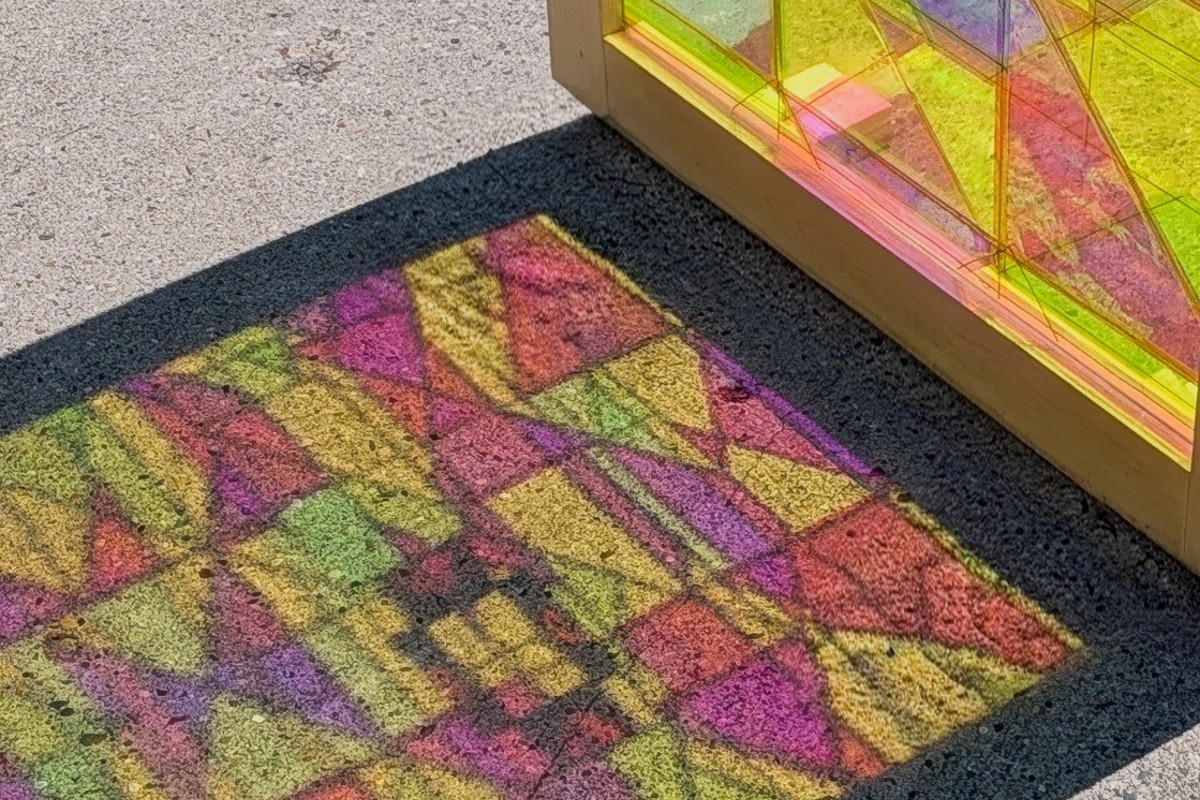
Quandahl’s public art installation reflects this historic artifact, expanding its original meaning for a contemporary audience. Visitors to Silent Monitor can stand in colorful panel ‘sides’ of the monitor art installation and survey the colorful reflections of these sunlit panels from within. Walking past and through the panels immerses the visitor into the art installation itself, giving the participant a close-up view of the light mosaic created by overlapping color patterns and textures. Colorful light reflections also extend across a central mosaic placed beneath the visitor, with the shape of this feature mimicking a silent monitor when viewed from above.
New Harmony Gallery of Contemporary Art Curator, Audra Verona Lambert, reflects on the impact of Quandahl’s installation. “This work serves to highlight New Harmony’s past within the framework of a public art piece firmly rooted in the present moment. Visitors to the work can reclaim the act of observation from the original silent monitor, turning a tool for measurement into a joyful installation teeming with color.”
Quandahl’s art installation allows us, as participant-observers, to reconsider how we look at the world around us by encouraging us to lead with curiosity rather than judgment. Quandahl observes, “Owen’s system reduced a person to a single color on a given day. But people aren’t blue or white, good or bad. We’re made up of a lot of things at once, and I wanted the light itself to prove that: it’s never just one hue, it’s all of them, layered and moving together.”
Visitors to Silent Monitor will be able to encounter a fresh take on Robert Owen’s innovative silent monitor, reimagined here as an immersive contemporary art experience. Historic New Harmony Director, Diane Sanders, notes of the installation: “As we commemorate the 200th anniversary of the Owen-Maclure community, Silent Monitor offers visitors an opportunity to encounter an important piece of New Harmony’s history through the lens of contemporary art. By encouraging participation and curiosity, Emily Quandahl’s installation creates a space where the past and present meet, inviting visitors to explore both the legacy of Robert Owen’s ideas and their relevance in our own time.”
The site will be activated by events throughout Fall 2026. Information will be made available at: https://www.usi.edu/new-harmony-gallery-of-contemporary-art/programs/events.
All events are free and open to the public. Information on the public artwork will be available on outdoor signage placed at the installation during gallery operating hours between 10 a.m. to 5 p.m. Tuesday through Saturday.
The Owen–Maclure group of educators and scientists settled in present-day New Harmony from 1825–27, and a suite of programming celebrating its impact is currently taking place in New Harmony through Summer 2027 led by Historic New Harmony. More information on the Owen–Maclure programming is available at: https://www.owenmaclure200.com/.
Emily Quandahl is a multi-disciplinary artist from the rural Midwest living and working in Minneapolis. Her compositions utilize bold palettes and textures that are built up in layers, pulling inspiration from folk craft and quilting traditions. She also creates from her surroundings by noticing and adapting textures, shapes, and colors into her forms. Her work deconstructs the expected. Quandahl has exhibited in Minnesota, Mexico and across the United States.